
Moravian Croats
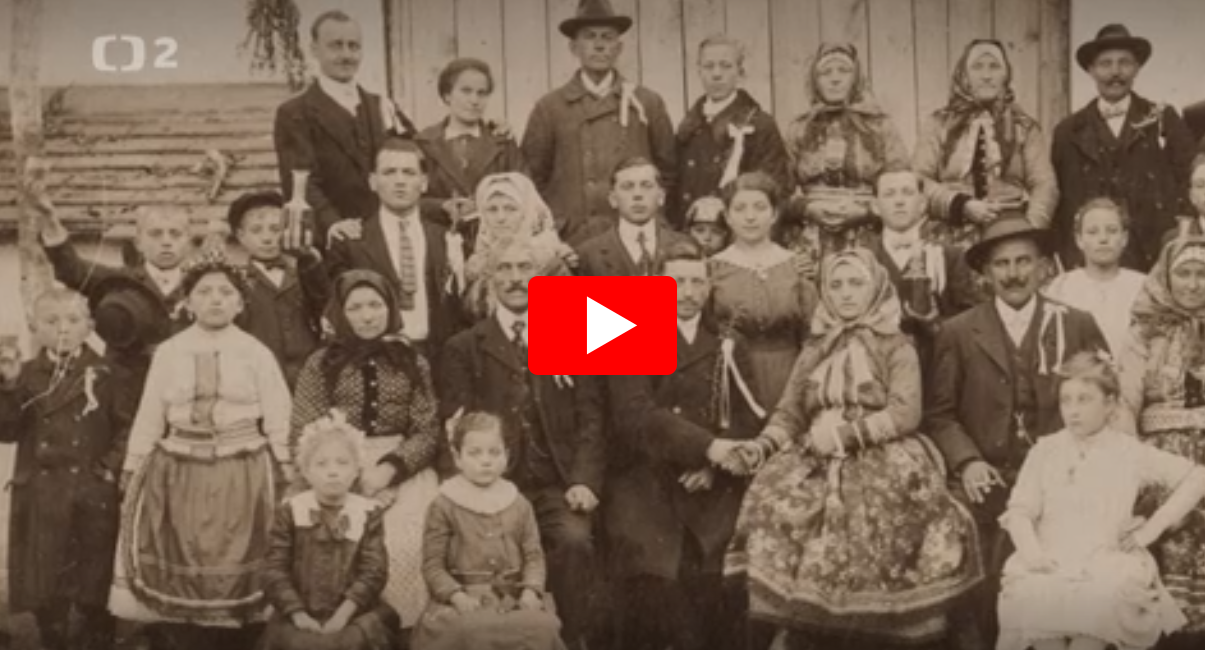
Watch the historic Czech Television documentary that, for the first time, comprehensively sheds light on nearly five hundred years of Croatian presence in our country, the reasons for their arrival, their integration into society, but above all the causes and consequences of their forced resettlement and liquidation as an ethnic group. In 1948 the communist regime turned them into exiles in their own country. To this day these injustices have not been redressed and are often not even named. We are proud to have been part of the filming.
From where to where?
During the 16th century, Croats left their homeland in fear of Turkish invasions and settled along the Hungarian-Austrian and Slovak-Moravian-Austrian borders. Today, Austrian Croats inhabit 46 villages with the capital Željezno (Eisenstadt). Several Croatian villages still exist today around Bratislava as well.
For good…
In both places these are communities with an uninterrupted continuity of existence. South Moravia also became a new home for the Croats, though not permanently. After the war, as a result of a decision by the Communist Party, they had to leave their villages.
The largest concentration of Croatian settlement in southern Moravia was around Břeclav — the villages of Charvátská Nová Ves, Lednice and Hlohovec.
The power of tradition
After 1530, Croats also settled in the Mikulov region, in the villages of Dobré Pole (Gutfjeld), Frélichov (Frjélištorf — now Jevišovka) and Nový Přerov (Nova Prerava). Croats resettled villages devastated by the Hussite and Czech-Hungarian wars of the 15th and 16th centuries, and thanks to their economic capability they soon belonged to the wealthiest inhabitants of the newly settled villages. It is certainly interesting that while the Croats in the Břeclav region, and similarly in today's Lower Austrian Marchfeld, gradually blended entirely with the local Slavic population over time, the Croats of the Mikulov region, although under strong influence from their surroundings, preserved their language, costumes, customs, music and dances.
Four languages
For four hundred years the Croats here formed a distinctive ethnic enclave, characterized, among other things, by a strong Christian feeling. Austria was definitely closer to them than the Czech-speaking regions, yet German never dominated here. Over the centuries they also entered into mixed marriages with Germans and Czechs, but every new family member, regardless of other nationality, became a Croat. The inhabitants of these villages maintained an unusual tri- or even quadrilingualism. They lived surrounded by a German environment, in villages with Czech authorities, and maintained contacts with Croatia as well as nearby Slovakia. They therefore spoke Czech, Slovak and German, and at home and in church, Croatian.
Putting things in order
However, the Croats living in the South Moravian villages automatically became citizens of the German Reich after the annexation of the Sudetenland, and the men were forced to enlist in the Wehrmacht. Many of them were taken prisoner or killed on the Russian front.
The Croats did not return to their completely destroyed villages until long after the war, and worked hard to put their homesteads back in order. After the war they again became Czechoslovak citizens, and in 1947, as strongly religious and conservative voters, they cast their votes mainly for the People's Party in the elections.
This too was regarded by the communists, who sought their resettlement, as a hostile act. The original inhabitants of these settlements, with a four-hundred-year history, were forced to leave their homes. Two and a half thousand people from Frélichov, Nový Přerov, Dobré Pole and other villages in southern Moravia were, by decision of the Action Committee of the Regional National Committee in Brno dated 11 June 1948, forcibly scattered among 118 villages in 34 districts of central and northern Moravia.
An injustice never redressed
Their abandoned homes were resettled by new inhabitants, similarly to other depopulated villages and towns in the borderlands. The Croatian inhabitants of the South Moravian villages were driven from their homes under the pretext of state unreliability, and their scattering was an act of politically motivated violence in which the principle of collective guilt — which is contrary to fundamental human rights — was applied. Yet to this day they have obtained no practical redress for the wrongs done to them. The loss of their homes and forced uprooting were borne very hard by the Moravian Croats for many years, and they never came to terms with this state of affairs. This is also why, every year since 1990, they have gathered in early September in Jevišovka for the Croatian village feast (hody).
Croats near Mikulov
Colonization in the Drnholec estate was first directed toward the derelict Frélichov, restored in the 1530s around the Gothic church. In 1570 the villages of Nový Přerov and Dobré Pole were founded. A smaller share of Croatian population also came to Brod nad Dyjí.
Ethnographic studies of the Croats' past in Moravia, and efforts to revive the national awareness of the Croatian national minority, focus above all on the village of Frélichov, renamed Jevišovka in 1950 after the river flowing through it.
Croatian folk costume
The Croats had much in common with the inhabitants of Podluží — on the one hand living conditions, and on the other cultural expression, whose mutual transmission naturally occurred through coexistence. Today it is hardly possible to determine precisely to what extent the Croatian and Podluží costumes influenced one another, just as it is difficult to decide to what degree, or in which direction, Croatian culture influenced that of Slovácko and vice versa. What is certain, however, is that the Croatian costume was very beautiful and picturesque, as the priest Alois Malec of Dobré Pole already noted in 1900 in the journal Český lid.
At the end of the 19th century, the costume was commonly worn in all three Croatian villages of the Drnholec region. By comparing older written reports, period depictions and later photographs, it can be established that the overall appearance of both the men's and women's Moravian Croat costume was preserved throughout the second half of the 19th century. Differences appeared in some items of clothing only at the beginning of the 20th century.
The last tailor who sewed and embroidered the men's Croatian costume was Jiří Pevner, born in 1870 in Frélichov. Acquiring a men's costume was costly — before the First World War the price of a complete set was the same as the price of a cow. The women's costume was cheaper, since women mostly sewed it themselves at home. Small haberdashery items — braids, laces — were obtained for them at fairs by travelling saleswomen, according to orders arranged in advance. Fabrics for making the garments were sold by the local Jewish merchant Ábeles. His shop offered a rich selection of goods, which he also ordered from Austria.
Fundamental changes in the way of dressing came to the inhabitants of the Croatian villages after the First World War, when men en masse put aside the costume and began to dress in the town fashion. Women still preferred traditional dress for a while longer, though already in a simplified form. The new outfit consisted of a home-sewn set — a jacket and skirt — using brightly coloured materials. Only ribbons and narrow laces remained as decorative elements, while the characteristic embroidery disappeared. Many Croatian women remained faithful to this style of dress even after the Second World War, and some even after the forced resettlement.
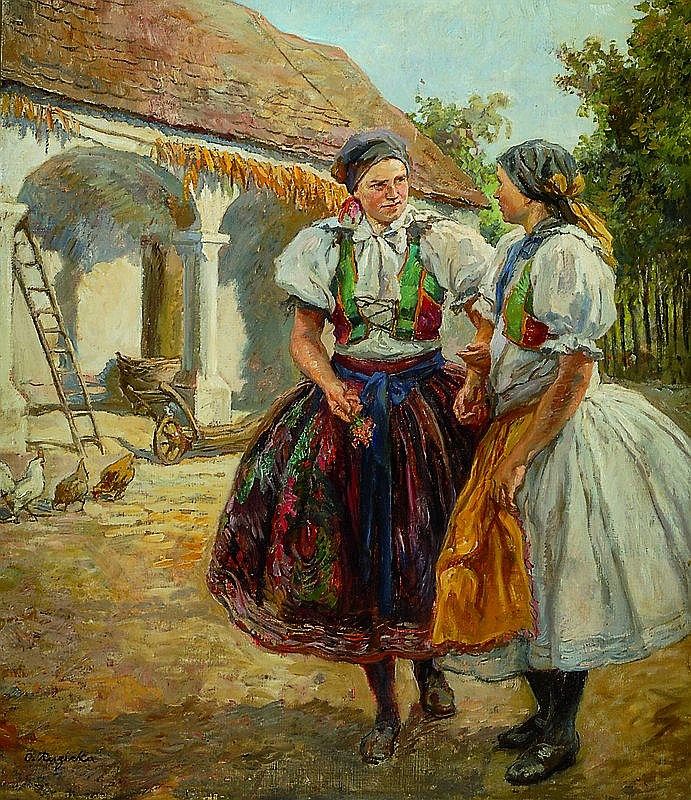
Othmar Růžička — painter of the life of the Moravian Croats
Prof. Othmar Růžička (1877–1962), a native of Vienna, devoted his work above all to the realistic depiction of the everyday life of the rural people of Pavlov and Novosedly, but especially of Jevišovka and its surroundings, which he first visited in 1905. He was captivated there not only by the striking surrounding landscape, full of calm and warm summer light, but also by the colourfulness of the folk costume and the character and temperament of the Moravian Croat inhabitants. The motifs from the life of this ethnic diaspora he discovered there were such a fascinating inspiration for Růžička that he kept returning permanently to this environment, and in 1930 he even bought a house in Jevišovka, then still called Frélichov.
Růžička's work, closely tied to the life of the people in the South Moravian countryside, comprises approximately a hundred canvases. Most of them capture the way of life and character of the cultural and social environment of the Moravian Croats of the Drnholec estate. They are currently held in private collections, and for that reason they have not yet been comprehensively published anywhere, nor properly edited or reproduced as a whole, though they would certainly deserve it. Within the context of further research, Růžička's work becomes an irreplaceable documentary material of high artistic value, helping to create a truthful and comprehensive picture of the life of the Moravian Croats.
Research and revival of the folk culture of the Moravian Croats
The life and culture of the Moravian Croats has attracted the attention of Moravian, Czech and Croatian researchers continuously since the beginning of the 19th century. Almost all reports and sources focus on customs, folk songs, music and dance.
These sources mention Croatian musicians from Frélichov, Dobré Pole and Nová Prerava. The musicians were called "guslari." They played the bagpipes (gajdy). The last bagpiper died in Dobré Pole around 1865.
These historical sources, as well as fieldwork, were also the basis of the research carried out by Zdeňka Jelínková — the "queen of dance folklore," as experts nickname her today — into the folk culture of the Moravian Croats. With her experience, knowledge and deep love for folk dance, Zdeňka Jelínková was a role model for everyone engaged with folk culture. A large part of her lifelong work, of enormous scope and immeasurable value, consists precisely of the results of her research into Moravian Croatian folk tradition, which was also praised by the Croatian researcher and ethno-choreologist Ivan Ivančan of Zagreb as a significant contribution to the folk culture of the Moravian Croats and Croats in general.
Alongside the research of Zdeňka Jelínková, the collecting activity of Josef Lawitschka, a native of Jevišovka, and Josef Mord of Vienna, also carries significant documentary and testimonial value.
The development of the folk tradition and of cultural and educational activity in this field has also, for many years, been the work of the Association of Citizens of Croatian Nationality in the Czech Republic. It was founded in Brno in 1991 and, with the support of the Society of Friends of the Southern Slavs in the Czech Republic, publishes both scholarly and literary works for the Croatian national minority.
The text and photographs used here come from the publication "Chorvaté na Mikulovsku" ("Croats in the Mikulov Region"), published by the Regional Museum in Mikulov, with the kind permission of the author, Ing. Stanislava Vrbková.